
If you live along the Wasatch Front, wildfire isn’t a distant threat. It’s a real risk that communities like Draper, Cottonwood Heights, and Farmington deal with every single fire season. That’s why arborist defensible space work has become one of the most important conversations Utah homeowners are having right now, and why getting it done right matters far more than most people realize.
What Is Defensible Space and Why Does It Matter in Utah?
Defensible space is the buffer zone you create between your home and the surrounding trees, shrubs, and vegetation. It gives firefighters room to work, slows the spread of an advancing fire, and reduces the chance that embers will ignite your structure. Without it, a home in a wildland-urban interface community is dramatically more vulnerable.
Utah’s Wasatch Front sits directly in what fire experts call the WUI, or Wildland-Urban Interface. That’s the zone where neighborhoods and wildlands meet, and it’s where fire behavior gets unpredictable and dangerous fast. Communities like Sandy, Bountiful, Saratoga Springs, and Farmington are all in this zone.
The standard defensible space model uses two zones. Zone 1 covers the area from zero to 30 feet around your home and requires the most aggressive clearing. Zone 2 extends from 30 to 100 feet and focuses on reducing the density and continuity of vegetation so fire can’t travel as easily. Both zones require different approaches, and both require real knowledge to do correctly.
According to the Utah Division of Forestry, Fire and State Lands, more than 330,000 acres burned in Utah in 2012 alone, and WUI communities continue to face increasing risk as development pushes further into fire-prone terrain. The 2012 Dump Fire in Saratoga Springs and the 2020 Parleys Canyon Fire are not abstract statistics to Wasatch Front residents. They are recent, local events that destroyed homes and threatened lives.
What’s the Difference Between a Certified Arborist and a General Tree Cutter?
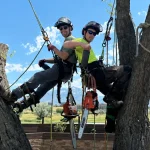
Not everyone who owns a chainsaw understands trees. A certified arborist has passed rigorous testing through the International Society of Arboriculture and must maintain continuing education to keep that certification active. They understand tree biology, root systems, structural failure patterns, and how specific species respond to pruning stress.
A general landscaper or tree cutter might look at your property and start removing whatever seems overgrown. But that’s not defensible space work. Real defensible space requires someone who can read a tree, identify hidden decay, recognize which species are high-resin fire carriers, and make strategic decisions about what to keep, what to prune, and what to remove entirely.
That’s why ISA-certified arborists approach defensible space differently. They’re not just clearing brush. They’re making science-backed decisions about tree spacing, canopy height, ladder fuel pathways, and long-term tree health. And in a fire-prone canyon community, those decisions can mean the difference between a home that survives and one that doesn’t.
Defensible Space Done Wrong Can Actually Make Things Worse
Here’s something most homeowners don’t know. Improperly executed defensible space work can stress your trees so badly that they become more fire-prone, not less. Over-pruning, removing too much live canopy at once, or making improper cuts all weaken a tree’s ability to defend itself against pests and disease.
Stressed trees produce less sap flow, which makes them more susceptible to bark beetle infestations. And in Utah, bark beetle-killed trees are some of the driest, most flammable fuel loads on a property. You can create a fire hazard while trying to prevent one, which is exactly the kind of outcome that a certified arborist is trained to avoid.
Proper pruning follows specific guidelines about how much canopy can be removed at one time, where cuts should be made, and how to raise the canopy height to eliminate ladder fuels without compromising the tree’s structural integrity. That’s not something you can learn from a YouTube video. It takes training, field experience, and a genuine understanding of how trees grow and respond to stress.
What an Arborist Actually Does During Defensible Space Work
When an ISA Certified Arborist evaluates your property for defensible space, they start with a full site assessment. They’re looking at tree species, age, condition, spacing, slope, and how the layout of your property interacts with prevailing wind patterns and potential fire approach directions. It’s a detailed process.
From there, they identify hazard trees. These are trees with structural defects, disease, or positioning that makes them a direct threat to your home or a likely ignition point. Professional hazardous tree removal is often part of defensible space work, especially in Zone 1 where the risk is highest. Removing a hazard tree isn’t just about fire safety. It’s also about protecting your home from failure during high-wind events, which often precede and accompany wildfires.
The arborist then develops a pruning and spacing plan. This includes raising canopy heights so ground fires can’t climb into the tree crowns, reducing shrub density to break up continuous fuel pathways, and creating separation between trees so fire can’t jump easily from one crown to the next. It’s strategic, not random. And because it’s done with the health of the remaining trees in mind, your property looks better and functions better long after the work is complete.
For homeowners who have already had a tree become a hazard or fallen during a storm, professional emergency tree services can address those immediate risks before a more thorough defensible space plan is put in place.
Defensible Space vs. Fuels Reduction: Understanding the Difference
These two terms get used interchangeably, but they’re not the same thing. Defensible space is property-focused. It’s about protecting your specific home by managing vegetation within that 0-to-100-foot zone. You own it, you control it, and you’re responsible for maintaining it.
Fuels reduction is landscape-scale work. It’s the kind of thing that fire agencies, land managers, and municipalities coordinate across large stretches of public or communal land. It might involve prescribed burns, mechanical clearing over many acres, or coordinated thinning projects across an entire watershed. That work is coordinated through agencies like the Utah Division of Forestry, Fire and State Lands, and it often happens on land adjacent to WUI communities rather than on private lots.
Understanding this distinction matters because some homeowners assume that if their city or county is doing fuels reduction nearby, their own property is protected. It’s not. Your defensible space is your responsibility, and it needs to be maintained on an ongoing basis, not just done once and forgotten. Fire doesn’t stop at property lines.
The Cost Question: Is Hiring an Arborist Worth It?
DIY defensible space work is possible for some tasks, like raking up debris or removing small shrubs. But tree pruning, canopy management, and hazard tree removal are different. These tasks require the right equipment, proper technique, and an understanding of how to do the work without creating new problems.
There’s also a liability angle that most homeowners overlook. If you prune a tree improperly and it fails during a windstorm or fire, that can create legal and insurance complications. And if your defensible space doesn’t meet the standards your insurance provider expects, an improperly maintained buffer zone could affect your ability to make a claim after a fire loss. Insurance companies are paying close attention to defensible space in Utah’s WUI communities.
Professional work done by licensed, insured arborists protects you in multiple ways. The trees stay healthier. The work is done safely. And you have documentation that your property was assessed and maintained by qualified professionals. That kind of credibility matters when you’re talking to your insurance company or a fire inspector. You can learn more about professional defensible space tree removal options by reviewing Advanced Tree Service’s tree removal services page.
The Utah Division of Forestry, Fire and State Lands (ffsl.utah.gov) also offers resources for WUI homeowners, including guidance on defensible space standards specific to Utah communities, and it’s worth reviewing those materials as part of your planning process.
Frequently Asked Questions
How do I know if my property needs defensible space work?
If your home is located in a Wasatch Front community that borders open hillsides, canyons, or undeveloped land, your property almost certainly benefits from defensible space evaluation. Signs that you need work include trees that overhang your roofline, dense shrub growth within 30 feet of your structure, and trees with heavy dead wood or canopy that touches neighboring trees. Advanced Tree Service serves Salt Lake County, Davis County, and Weber County and can assess properties in communities from Ogden to Sandy. A site visit is the best way to know exactly what your property needs and where the most urgent risks are.
Can I do defensible space work myself, or do I need a professional?
Some basic tasks, like removing dead leaves, clearing small brush, and maintaining gravel or rock ground cover near your foundation, are reasonable DIY projects. But anything involving tree pruning, canopy raising, or the removal of trees near structures should be handled by a professional. Improper cuts and over-pruning can stress trees and make them more vulnerable to bark beetles and drought, which increases fire risk. Advanced Tree Service has ISA Certified Arborists serving communities throughout Salt Lake, Davis, and Weber Counties who can handle the technical work correctly and safely.
How often does defensible space need to be maintained?
Defensible space is not a one-time project. Vegetation grows back, trees drop limbs, and new hazards develop over time. Most fire safety professionals recommend at least an annual inspection and maintenance cycle, with additional attention after major wind events or drought years. In Utah’s climate, where hot dry summers follow wet springs, vegetation can change dramatically from one season to the next. Advanced Tree Service works with homeowners across the Salt Lake Valley and northern Utah to establish ongoing maintenance plans that keep their properties in compliance and their trees healthy year after year.
What’s the difference between defensible space work and regular tree trimming?
Regular tree trimming is typically done for aesthetics, clearance, or general health. Defensible space work is done with fire behavior in mind. That means focusing on ladder fuel removal, canopy separation, crown raising to specific heights, and strategic spacing rather than just the appearance of the tree. It requires someone who understands how fire moves through vegetation, not just how to make a tree look tidy. Advanced Tree Service’s certified arborists serving Salt Lake, Davis, and Weber Counties approach defensible space pruning with both tree health and fire safety as equal priorities, which produces better outcomes for your trees and your property.
Does homeowners insurance require defensible space in Utah?
Insurance requirements vary by carrier and policy, but many insurers writing policies in Utah’s WUI communities are increasingly focused on defensible space as part of their underwriting criteria. Some carriers may require documentation of maintained defensible space, and failure to maintain it could affect your ability to file a successful claim after a wildfire loss. It’s worth reviewing your policy and talking to your insurance agent directly about what they expect. Advanced Tree Service serves homeowners throughout Salt Lake, Davis, and Weber Counties and can provide documentation of professional arborist work, which may support your insurance compliance requirements.
Conclusion
Wildfire risk along Utah’s Wasatch Front is real, it’s well-documented, and it’s not going away. Defensible space is one of the most practical things a homeowner can do to protect their property, and doing it with the knowledge of a certified arborist makes that work far more effective. The trees that remain after professional defensible space work are healthier, better positioned, and genuinely contribute to your property’s fire resilience.
Ready to Create Defensible Space Around Your Utah Property?
Advanced Tree Service’s ISA Certified Arborists serve Salt Lake, Davis, and Weber Counties with professional defensible space clearing and hazardous tree removal. Call (801) 272-3344 or visit advancedtreeserviceut.com/contact-us for a free estimate.