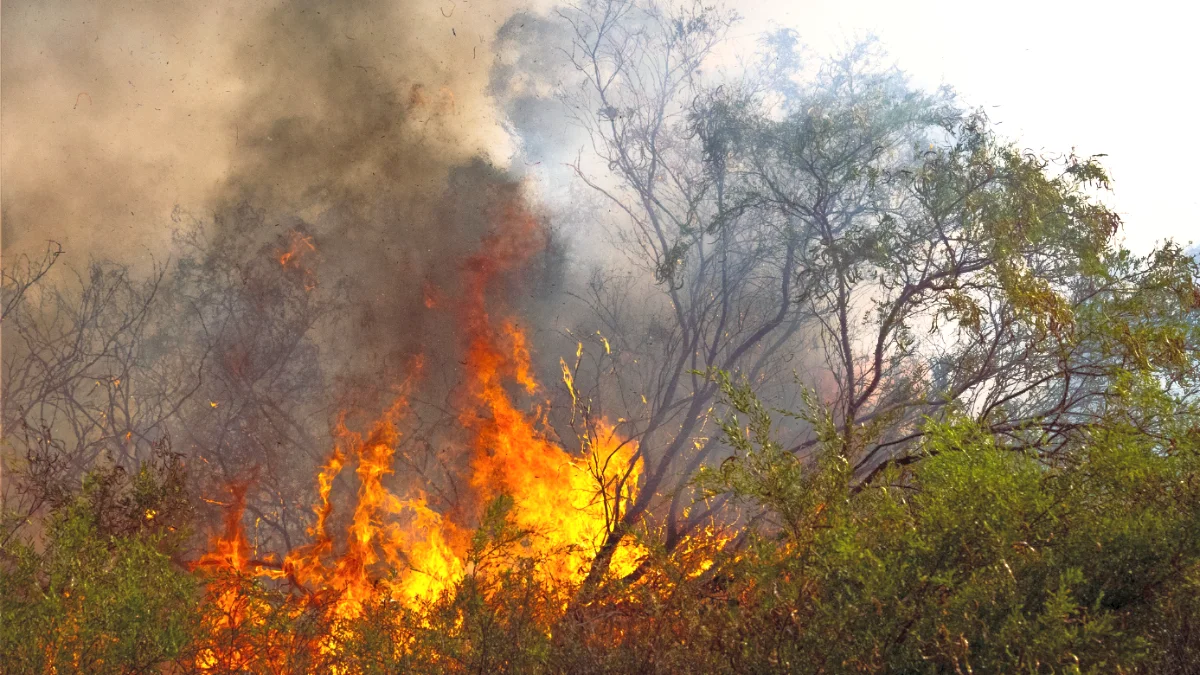
Fire season is coming, and most Utah homeowners aren’t ready. Fire season property cleanup isn’t a weekend chore you can push to June. By the time flames are visible on a ridge above the Wasatch Front, it’s already too late to start clearing.
The good news is that defensible space works. Research from the Insurance Institute for Business and Home Safety shows that homes with cleared, well-maintained zones around the structure survive wildfires at dramatically higher rates than those without. What you remove from your property in spring and early summer matters more than almost any other preparation you can make.
Dead and Dying Trees: The Highest Priority on Your Property
Dead trees are standing fuel. That’s the simplest way to describe the risk. A bark beetle-killed pine, which you’ll find throughout the Wasatch Front after years of drought stress, holds almost no moisture. It ignites fast, burns intensely, and throws embers hundreds of feet in every direction.
Utah’s ongoing drought conditions have accelerated bark beetle activity across Salt Lake, Davis, and Weber Counties. You don’t have to live in a canyon to have one of these trees on your property. Many homeowners in Farmington, Sandy, and the east bench Salt Lake neighborhoods have Gambel oak or scrub pine that’s quietly dying and drying out right now.
If you see a tree with a faded crown, brittle bark, small pinholes in the trunk, or large sections of missing bark, treat it as a fire hazard first and a tree second. Getting it removed before fire season peaks is the single most effective thing you can do to reduce risk on your property. You can learn more about what that process looks like through Advanced Tree Service’s professional tree removal services.
Dead Limbs and Hanging Branches
Dead limbs don’t just fall on people. They carry fire. When a ground-level fire pushes heat upward, dead hanging branches act as wicks that pull flames straight into the canopy. That’s called canopy fire, and it moves fast enough to outrun people and overwhelm structures in minutes.
“Widow-makers” is the term arborists use for large dead branches hanging in the crown. They’re dangerous in windstorms, but during fire season they become something worse. A single ember landing on a cluster of dry dead wood forty feet up can ignite the entire tree from the inside out.
Walk your property and look up. If you see gray, leafless branches that don’t move the way the rest of the canopy does, or large limbs that crack and creak in wind, those need to come down before July. Pruning dead wood out of established trees is straightforward work that significantly reduces both fire risk and storm hazard.
Dry Grass, Annual Weeds, and Fine Fuels Within 30 Feet
Fine fuels are the first thing that ignites. Dry annual grass, tumbleweeds, foxtail, and cheatgrass all ignite in under a second in the right conditions. Utah has a lot of them. Cheatgrass in particular has spread aggressively across the Wasatch Front and is considered one of the primary drivers of wildfire spread in the intermountain West.
Zone 1 is the area within 30 feet of your home. In this zone, mow grass to under 4 inches and keep it there through the dry months. Pull annual weeds before they go to seed and dry out. If you have cheatgrass on a slope near your home, treat it seriously. Slopes accelerate fire spread dramatically because heat rises ahead of the flame front and pre-dries the fuel above.
The Utah Division of Forestry, Fire and State Lands (ffsl.utah.gov) publishes specific defensible space guidance for Utah homeowners that breaks down Zone 1 and Zone 2 management in detail. It’s a practical resource worth bookmarking before you start your cleanup work this spring.
Shrubs and Brush Touching Your Structure
Shrubs that touch or overhang the house create a direct fire pathway. There’s no gap, no break, no moment where fire has to work to reach the siding or roofline. It just travels. Ornamental junipers, which are extremely common in Utah landscaping, are particularly dangerous because they contain volatile oils that cause them to burn explosively.
Zone 1 management means keeping all shrubs and woody plants away from the foundation and the siding. The standard guidance is to maintain at least 5 feet of clearance between any plant material and the structure itself. That means no plants touching the walls, no branches brushing the eaves, and no ground cover running unbroken from the yard to the foundation.
This also applies to trellises, climbing vines, and any vegetation growing up or over the structure. They’re fire pathways. Removing them before fire season is a straightforward job, but it’s one that many homeowners overlook because the plants look healthy and decorative.
Ladder Fuels: Low Branches That Connect Ground to Canopy
Ladder fuels are exactly what they sound like. They’re the low branches on trees that allow a ground-level fire to climb up into the canopy. Once fire gets into the canopy, it moves at a completely different speed and scale than a ground fire.
The standard practice for fire mitigation is to prune the lower branches of trees within Zone 1 up to 6 to 10 feet from the ground. This removes the physical connection between grass-level fire and the tree crown. It doesn’t harm the tree when done correctly. In fact, most mature trees in Utah benefit from this kind of structural pruning because it removes weight and reduces storm damage risk as well.
For trees on slopes, the pruning height should be greater because fire moves uphill faster and the effective “reach” of a ground fire on a slope is higher than on flat ground. ISA Certified Arborists can evaluate your specific trees and site conditions to determine the right pruning approach for your property.
Debris in Gutters and on the Roof
Gutters filled with pine needles and dry leaves are one of the most common ignition points during a wildfire. Ember cast, which is the process where a wildfire throws burning embers ahead of the main fire front, can land embers on your roof and in your gutters from miles away. If those gutters are packed with dry organic material, ignition is nearly instantaneous.
Clean your gutters completely before fire season. That means all debris, not just the big chunks. Pine needles pack densely and stay dry even after rain because the gutter walls shield them. Utah homeowners near conifers, particularly those on the east bench near the Wasatch foothills, should plan to clean gutters at least once in spring and again in early summer.
While you’re up there, check the roof surface as well. Debris accumulating in roof valleys, around chimneys, and in any low-slope area creates the same ember-landing hazard as gutters. Clear it all.
Combustibles Stored Against the House
Woodpiles stacked against the foundation are fuel. So are propane tanks placed near the structure, bags of bark mulch against the siding, and patio furniture left in contact with the walls. During a wildfire event, these items become ignition points that help fire reach the house even if the house itself would have otherwise survived ember cast.
Move woodpiles at least 30 feet from the structure, or store them in a detached structure that isn’t attached to the home. Propane tanks should have at least 10 feet of clearance from the home and from any combustible material. Patio furniture and cushions should be moved indoors or away from the structure when fire conditions are elevated.
Mulch is a specific problem in Utah. Many homeowners use bark or wood chip mulch right against the foundation. That material dries out completely by midsummer in Utah’s climate and is highly combustible. Switching to gravel or decomposed granite within 5 feet of the foundation is one of the most effective and low-maintenance fire mitigations available.
Overgrown Vegetation in Zone 2
Zone 2 runs from 30 to 100 feet from your home. In this zone, the goal isn’t total removal. It’s reducing the continuity of fuel so fire can’t run unbroken toward the structure. That means thinning shrubs and trees so there are gaps between plants, and removing vegetation from the space beneath tree canopies.
Shrubs in Zone 2 should be spaced so they’re not touching each other. Trees should have enough separation between crowns that fire can’t jump directly from one canopy to the next. This is sometimes called “board feet spacing,” but the practical rule is simple: if you can’t see sky between the crowns of adjacent trees, they’re too close for fire season safety.
Utah’s Wasatch Front communities sit in what fire scientists call the wildland-urban interface, or WUI. According to the Utah Division of Forestry, Fire and State Lands, Utah has more than 350,000 homes in the WUI, meaning they are directly adjacent to or intermixed with wildland vegetation. Zone 2 management is one of the primary defenses for these homes.
Utah Timing: Why Spring Preparation Matters
Utah’s fire season typically peaks between July and September. But the preparation window closes faster than most homeowners expect. Tree service contractors across the Wasatch Front book up quickly in spring, and by late June many are running weeks-long waiting lists.
The 2026 drought forecast for Utah and the broader intermountain West is not encouraging. Drought conditions reduce soil moisture and tree health, which means more bark beetle activity, more dead trees, and more dry fuel across the landscape. Getting tree work scheduled in April or May means it actually happens before fire season rather than during it.
If you have a tree that comes down unexpectedly, or a storm creates a hazardous situation mid-season, Advanced Tree Service’s emergency tree services are available for urgent situations across Salt Lake, Davis, and Weber Counties.
Frequently Asked Questions
How do I know if a tree on my property is dead or just dormant?
Dead trees typically show several signs that distinguish them from dormant ones. Look for bark that’s peeling away in large sections, branches that snap rather than bend, and a complete absence of buds in spring when surrounding trees are leafing out. Fungal growth at the base or on the trunk is another strong indicator of a tree in decline. Advanced Tree Service’s ISA Certified Arborists serve homeowners throughout Salt Lake, Davis, and Weber Counties and can assess any tree you’re uncertain about before fire season. Getting a professional evaluation is faster and more reliable than guessing, especially when fire risk is involved.
How far back do I need to clear vegetation from my home for fire season?
Utah’s defensible space guidelines follow a zone system. Zone 1 covers 0 to 30 feet from the structure and requires the most aggressive management, including mowed grass, removed dead plants, and no shrubs touching the home. Zone 2 covers 30 to 100 feet and focuses on reducing fuel continuity rather than total clearing. Advanced Tree Service works with homeowners across the Wasatch Front, including communities in Salt Lake, Davis, and Weber Counties, to evaluate and clear both zones before the July fire season peak. The right approach depends on your specific terrain, slope, and vegetation type.
Is it too late to schedule tree removal if fire season is already starting?
It depends on what’s happening on your property and how booked local contractors are. For non-emergency tree removal, spring scheduling is strongly preferred because it gives crews time to fit your project in before fire season demand peaks. But if you have a dead tree, a hanging limb, or another urgent hazard, Advanced Tree Service provides emergency tree services to homeowners throughout Salt Lake, Davis, and Weber Counties. Don’t wait on a tree that’s actively posing a risk. A dead tree doesn’t give you notice before it falls or before it becomes a fire hazard.
What trees are most dangerous in Utah during fire season?
Bark beetle-killed pines are the highest-risk trees in Utah’s WUI because drought stress and beetle activity have left many standing dead trees throughout the Wasatch Front. Gambel oak, which is extremely common on Utah’s east-facing slopes, also burns intensely and spreads fire quickly through its root system. Ornamental junipers and arborvitae planted as hedges near homes are volatile and ignite readily. Advanced Tree Service’s arborists are familiar with the specific species and conditions found across Salt Lake, Davis, and Weber Counties and can identify which trees on your property carry the greatest fire season risk.
Do I need a permit to remove a tree in Salt Lake County before fire season?
Permit requirements vary by municipality. Some Salt Lake County cities require permits for removing trees above a certain trunk diameter, and a few have protections for specific species. That said, hazardous tree removal for fire mitigation is often treated differently than standard removal, and some jurisdictions have streamlined processes for documented fire hazards. Advanced Tree Service is familiar with local permit requirements across Salt Lake, Davis, and Weber Counties and can help homeowners understand what’s needed before starting work. When you schedule a free estimate, the crew can walk through the regulatory side along with the tree assessment.
Conclusion
Fire season in Utah doesn’t wait, and neither should your preparation. The steps outlined here are practical, achievable before summer, and backed by the same defensible space science that fire agencies across the West have used for decades. Start with the highest-risk items, work through your zones systematically, and don’t let the calendar get ahead of you.
Get Your Utah Property Ready for Fire Season
Advanced Tree Service’s ISA Certified Arborists help homeowners across Salt Lake, Davis, and Weber Counties prepare for fire season with professional tree removal, hazardous limb clearing, and defensible space work. Call (801) 272-3344 or visit advancedtreeserviceut.com/contact-us/ for a free estimate.