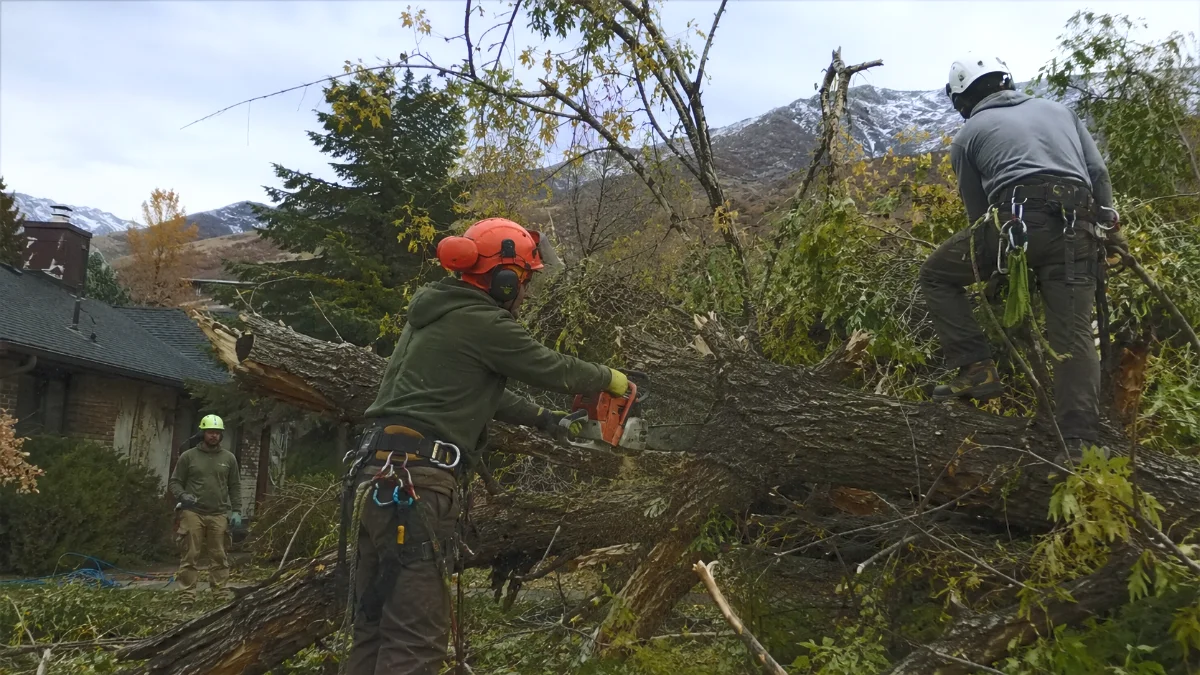
A fallen tree on your roof at midnight. A massive limb hanging over your car after a summer microburst. These aren’t just stressful moments, they’re genuine emergencies that demand fast, smart action. Knowing what to do in the first few hours after storm damage can protect your family, your home, and your insurance claim, which is exactly why having a trusted emergency tree service in Utah on your radar before disaster strikes matters so much.
Why Utah Storms Are So Hard on Trees
Utah’s weather is not gentle. The Wasatch Front sits in a unique geographic position that makes it one of the more demanding environments for trees in the entire western United States.
Summer thunderstorms along the Wasatch Front are famous for producing microbursts, which are sudden, violent downdrafts that hit the ground and fan out in all directions with winds that can exceed 100 miles per hour. These events can snap mature cottonwoods and maples in seconds, and they tend to strike without much warning. Canyon-mouth winds from places like Parley’s Canyon and Little Cottonwood Canyon add another layer of risk, pushing powerful gusts directly into residential neighborhoods in Salt Lake, Murray, and Sandy.
Late spring and early fall snowstorms create a different but equally destructive problem. When a heavy, wet snowstorm hits before trees have dropped their leaves, the foliage acts like a sail, catching enormous amounts of snow weight on branches that were never designed to handle it. According to the Utah Division of Emergency Management, severe storms and high-wind events are among the most frequently declared weather emergencies in the state, with tree and property damage accounting for a significant share of reported losses. You can review Utah’s current hazard data at bereadyutah.gov to understand just how common these events are across the Wasatch Front.
Your First 30 Minutes: Safety Before Everything Else
The moment a tree comes down, your instinct might be to run outside and assess the damage. Don’t. The first priority is always safety, not cleanup.
If a tree or large limb has fallen near power lines, treat every wire on the ground as live and energized. Stay at least 30 feet away and call Rocky Mountain Power immediately. Do not attempt to move branches away from lines yourself, and don’t let children or pets anywhere near the area. A downed power line can electrify the wet ground around it, which means the danger zone extends far beyond the wire itself.
If a tree has landed on your house, stay out of the affected rooms and do not go onto the roof under any circumstances. The structure beneath the tree may be compromised in ways that aren’t visible from the ground. Get everyone out of that part of the house and call for help. Once the immediate area is safe, take as many photos and videos as you can before any cleanup begins. That documentation is critical for your homeowners insurance claim.
Emergency vs. Can It Wait: How to Assess the Damage
Not every piece of storm damage requires an immediate call at 2 in the morning. Knowing the difference between a true emergency and a situation that can wait until business hours helps you make smarter decisions under pressure.
A tree or large limb on your home, garage, fence, or vehicle is an emergency. A large hanging limb, sometimes called a widow-maker, that is suspended over a structure, driveway, or area where people walk is an emergency. A tree that is visibly leaning toward a structure after a storm, especially if the root ball has begun to lift, is an emergency. These situations involve active or imminent risk of further damage or injury, and they need professional attention right away. Our emergency tree removal and storm response services are built specifically for these scenarios.
A tree that has fallen in an open area of your yard, away from structures and utilities, is serious but generally not an emergency in the same sense. A stump left behind after a tree snapped is not urgent. Scattered small branches across the lawn can typically wait. The key question to ask yourself is: if this situation gets worse in the next few hours, does someone get hurt or does a structure get damaged? If the answer is yes, it’s an emergency.
What to Expect When You Call an Emergency Tree Service
Calling for emergency tree help after a storm can feel chaotic, especially if it’s the middle of the night. Understanding what happens next can help you stay calm and prepared.
When you call a qualified emergency tree service, the first thing that happens is a rapid response assessment. A crew will arrive to evaluate the full scope of the situation before any cutting begins. This matters because storm damage is almost never as simple as it looks. A tree on a roof may have cracked rafters. A leaning tree may have root damage that changes how it needs to be rigged for removal. Rushing into a cut without understanding the full picture can cause the tree to move in an unexpected direction, which can cause far more damage than the storm itself did.
The first priority on site is hazard mitigation, not full cleanup. That means stabilizing the situation, removing the most dangerous immediate threat, and making the area safe. Full cleanup and debris removal typically follows once the acute risk is addressed. For trees on structures, crane-assisted removal is often the safest method because it allows the crew to lift sections of the tree straight up rather than letting them fall. That’s why working with a company that has crane capabilities and ISA Certified Arborists on staff makes such a significant difference in these situations.
Why ISA Certified Arborists Matter in a Tree Emergency
Anyone with a chainsaw can show up after a storm. But that doesn’t mean they can safely remove a tree from your roof without causing further structural damage.
ISA Certified Arborists have completed rigorous training and testing through the International Society of Arboriculture, and they understand tree biology, failure patterns, and physics in ways that directly apply to emergency removals. They know how to read a tree that has already partially failed, identify hidden tension and compression in the wood, and plan cuts that remove the hazard without creating a new one. That knowledge is not something you develop in a weekend course.
Proper rigging technique is one of the most critical skills in emergency tree work. When a large limb or section of trunk is suspended over a structure, it has to be lowered in a controlled way using ropes, pulleys, and sometimes a crane. A miscalculated cut on a loaded limb can send hundreds of pounds of wood crashing through a roof. The combination of certified expertise, proper equipment, and nearly 30 years of experience with Utah-specific tree species and storm conditions is what separates a safe emergency removal from a dangerous one. If you want to understand the full scope of what professional removal involves, our tree removal services page explains the process in detail.
Documenting Storm Damage for Your Insurance Claim
Homeowners insurance can cover a significant portion of storm-related tree damage, but the coverage depends heavily on what happened and how well you document it.
Generally speaking, if a tree falls on an insured structure, such as your home, garage, or fence, most homeowners policies will cover the cost of removing the tree from that structure and repairing the damage. If a tree falls in your yard without hitting anything, coverage for removal is much less common and often limited to a small dollar amount if it’s covered at all. Policies vary widely, so reviewing your specific coverage before a storm happens is always worthwhile.
Documentation is everything. Before any cleanup begins, photograph the fallen tree from multiple angles. Capture the base of the tree, the point of failure, the structure it landed on, and any visible damage to the structure itself. Save any communications with your tree service company, including the assessment report and the invoice. Most insurance adjusters will want to see that a licensed, insured professional handled the removal. Ask your tree service for proof of insurance and a detailed written estimate, both of which will support your claim.
What Not to Do After Storm Damage
Some of the most common mistakes made after storm damage are understandable, but they can turn a bad situation into a much worse one.
Don’t try to cut the tree yourself. This is the most important rule. A tree that has already partially failed is under enormous mechanical stress, and cutting it in the wrong place can cause it to move violently and without warning. Even experienced professionals approach storm-damaged trees with great caution. A homeowner with a rented chainsaw and good intentions is not equipped to manage that risk safely.
Don’t drive under a hanging limb to get your car out of the garage. Don’t let your kids play in the yard while a large limb is still suspended overhead. Don’t wait to call for help if a tree is on your roof, even if the damage looks minor from the outside. Roof structures can fail progressively, and rain or wind in the hours after a storm can turn a manageable situation into a catastrophic one. And don’t hire a company that can’t show you proof of insurance. If a crew member is injured on your property while working for an uninsured company, the liability can fall on you. To get the process started with a team you can trust, you can request a free estimate through our contact page.
Frequently Asked Questions
How fast does Advanced Tree Service respond to storm emergencies in Utah?
Advanced Tree Service provides emergency response across Salt Lake County, Davis County, and Weber County, covering communities from Ogden down to Sandy. Response time depends on the volume of calls during a major storm event, but emergency calls are prioritized ahead of routine work. When you call (801) 272-3344, you’ll be connected with a team that understands the urgency of the situation. The goal is always to get eyes on the most dangerous situations as quickly as possible. We’ve been responding to Utah storm emergencies since 1996, so our team knows how to triage multiple calls efficiently during high-demand periods.
Does homeowners insurance cover emergency tree removal in Salt Lake City?
Insurance coverage for tree removal depends on whether the tree hit a covered structure. In most cases, if a tree falls on your home, garage, or another insured structure, your homeowners policy will cover the removal cost and structural repairs, subject to your deductible. If the tree fell in the yard without causing structural damage, coverage is typically limited or nonexistent. Advanced Tree Service serves homeowners across Salt Lake, Davis, and Weber Counties and can provide the documentation your insurance company will need, including a detailed written estimate and proof of our licensing and insurance. Always check your specific policy and contact your insurance provider as soon as possible after the event.
Is it safe to stay in my home if a tree has fallen on the roof?
A tree on your roof should be treated as a structural emergency until a professional assesses the situation. The visible damage from the outside rarely tells the whole story. Rafters, sheathing, and load-bearing elements can be compromised in ways that aren’t obvious until someone is inside or on the structure. Advanced Tree Service responds to roof-impact tree emergencies throughout Salt Lake, Davis, and Weber Counties and can help you understand the scope of the damage quickly. Until a professional clears the affected area, it’s safest to stay out of the rooms directly below or adjacent to where the tree landed. Getting everyone to a safe part of the house and calling for help is always the right first move.
What makes Utah’s storm season so dangerous for trees?
The Wasatch Front experiences a combination of weather events that are particularly damaging to trees. Summer microbursts can produce localized winds strong enough to snap mature trees at the trunk. Canyon-mouth winds from Parley’s Canyon and Little Cottonwood Canyon regularly push damaging gusts into Salt Lake Valley neighborhoods. Late spring and early fall snowstorms hit trees while they’re still fully leafed out, loading branches with far more weight than they can handle. Advanced Tree Service has been managing storm damage across Salt Lake, Davis, and Weber Counties since 1996, giving our team direct experience with all of these Utah-specific conditions. That local knowledge shapes how we assess and respond to each situation.
Can I just cut the fallen tree myself to save money?
Attempting to cut a storm-damaged tree yourself is one of the most dangerous things a homeowner can do after a storm. Trees that have already partially failed are under unpredictable mechanical stress. A cut in the wrong place can cause the trunk or limb to kick back, roll, or drop suddenly with enormous force. The risk is especially high when a tree is resting against a structure, because the structure itself becomes part of the tension system. Advanced Tree Service serves homeowners throughout Salt Lake, Davis, and Weber Counties with ISA Certified Arborists who are trained specifically for these high-risk removal scenarios. The cost of professional removal is almost always far less than the cost of repairing additional damage caused by an untrained attempt.
Conclusion
Storm damage is disorienting and stressful, but the steps you take in the first few hours after a tree comes down can make a real difference in how safely and smoothly things get resolved. Prioritizing your family’s safety, documenting the damage thoroughly, and calling qualified professionals are the three things that matter most. Utah’s weather is unpredictable, but your response to it doesn’t have to be.
Need Emergency Tree Service in Utah Right Now?
Advanced Tree Service responds to tree emergencies across Salt Lake, Davis, and Weber Counties. Whether a tree has fallen on your home, a limb is threatening your property, or storm damage has left your yard unsafe, call us immediately at (801) 272-3344. Our ISA Certified Arborists are ready to help. You can also reach us at advancedtreeserviceut.com/emergency-services/.