
If you’ve ever looked at your yard and thought, “Everything seems pretty well spaced out… we should be fine,” you’re not alone.
A lot of properties in Northern Utah look safe at first glance. Trees trimmed. Grass cut. Nothing obviously overgrown.
But wildfire doesn’t move the way most people expect.
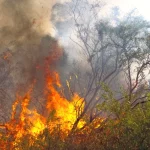
It doesn’t just stay on the ground. It climbs.
And one of the main ways it does that is through something called ladder fuels.
Once you understand how that works, you start to see your yard a little differently.
What Are Ladder Fuels?
Ladder fuels are pretty much what they sound like, they’re what let a fire climb.
They act like a bridge between what’s burning on the ground and what’s up in the trees.
That might include:
- Dry grass or pine needles at ground level
- Small shrubs or brush sitting underneath trees
- Low-hanging branches that haven’t been cleared out
- Dense growth that fills in the space between the ground and the canopy
Individually, none of these seem like a big deal. But when they’re stacked close together, they create a path.
Fire starts low. It moves into that lower vegetation. From there, it reaches branches. Then the canopy.
And once it’s in the canopy, things change quickly.
If you want a broader look at how spacing plays into this, it ties closely into defensible space planning, you can read more about that.
How Fire Travels: Ground to Canopy to Structure
This is the part most people don’t see coming.
Fire doesn’t need a direct line to your house. It just needs a path.
It usually starts at ground level. Dry grass, leaves, small debris, that’s the first layer.
From there, if ladder fuels are present, it climbs. Slowly at first. Then faster.
Low branches catch. Shrubs ignite. Heat builds.
Eventually, it reaches the canopy. From there, it can spread across the tops of trees without even touching the ground again.
And at that point, your home doesn’t have to be surrounded by fire for it to become a problem.
Embers can travel. Radiant heat builds. Rooflines and nearby structures become exposed.
That’s why ladder fuels matter so much. They’re what connect all of these layers.
Break that connection, and you slow the fire down. Sometimes enough to make a real difference.
High-Risk Tree Species and Vegetation in Northern Utah
Not all trees behave the same when it comes to fire.
Some species are more prone to holding onto dry material. Others have dense branching that makes it easier for flames to spread.
In Northern Utah, a few common risk factors show up over and over:
- Trees with low, dense branching
- Evergreens that hold needles close to the trunk
- Areas where shrubs are growing directly under trees
- Properties where debris tends to collect and stay
It’s not always about the species alone, it’s how everything is arranged.
You can have a healthy tree that still contributes to fire risk if it’s surrounded by the wrong conditions.
That’s why ladder fuel removal isn’t about cutting everything down. It’s about identifying what creates that vertical connection and breaking it.
How Advanced Tree Service Removes Ladder Fuels
There’s no single checklist that works for every property.
Some yards need light pruning. Others need more involved work, clearing out understory growth, adjusting spacing, sometimes removing smaller trees entirely.
It starts with looking at how everything connects.
Where does the ground fuel sit?
What’s directly above it?
How close are those layers to each other?
From there, the work usually involves:
- Clearing out brush and buildup near the base of trees
- Removing or raising lower branches to create vertical space
- Thinning out areas where vegetation is too dense
- Addressing spots where fire could easily move upward
It’s not about making everything look “clean.” It’s about changing how fire would behave if it reached the property.
And that kind of work needs to be done carefully.
Too much removal, and you create new problems, sun exposure, erosion, stressed trees.
Too little, and the risk stays in place.
That balance is where experience matters.
If you want to see how this fits into a larger plan, it’s part of a broader wildfire mitigation approach.
Ladder Fuel Removal vs. Tree Removal – What’s the Difference?
People hear “ladder fuel removal” and assume it means cutting trees down. Sometimes it does. Most of the time, it doesn’t.This gets mixed up a lot.
Ladder fuel removal is more targeted.
It’s about breaking the vertical path fire uses, not clearing the entire landscape.
That might mean:
- Trimming lower branches instead of removing the tree
- Clearing out what’s growing underneath
- Increasing space between layers
Tree removal comes into play when a tree is too close, too dense, or too risky to keep.
But the goal isn’t removal for the sake of it. It’s reducing how easily fire can move.
Most properties end up needing a mix of both approaches, depending on what’s there.
Frequently Asked Questions
They’re the materials that let fire climb from the ground into trees. Usually a combination of grass, brush, and low branches that connect those layers together.
There’s no one way to do it. A lot of it comes down to what’s happening under and around the trees. Clearing out that lower growth is usually the first step. After that, it might be trimming branches up a bit or spreading things out so fire doesn’t have an easy path upward.
It’s less about the species and more about the setup. Trees with low-hanging branches, or ones sitting over thick brush, tend to create that “ladder” effect. Add in some dry debris underneath, and it starts to connect everything together.
Not really. Trimming focuses on the tree. Ladder fuel removal focuses on how fire moves through the entire area. Sometimes they overlap, but the goal is different.
Schedule a Free Defensible Space Assessment
Most ladder fuel issues aren’t obvious until someone points them out.
You can walk your yard a dozen times and still miss how things connect from the ground up.
That’s usually where an assessment helps.
If you’re in Salt Lake, Davis, or Weber County and want a clearer idea of where your property stands, and what could be improved, you can start with a FREE ESTIMATE from Advance tree service.
No pressure. Just a closer look at what’s there, and what might need attention before fire season picks up.